Shaezar's sanctuary.

Chapter XX

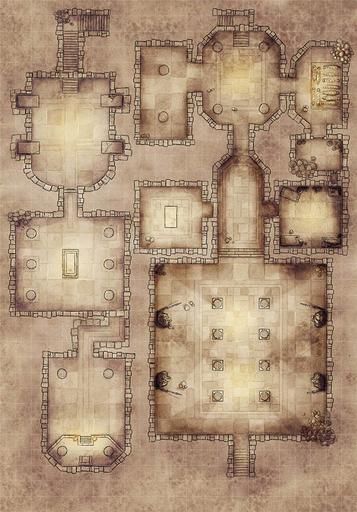
The Lich's lair (sanctuary)

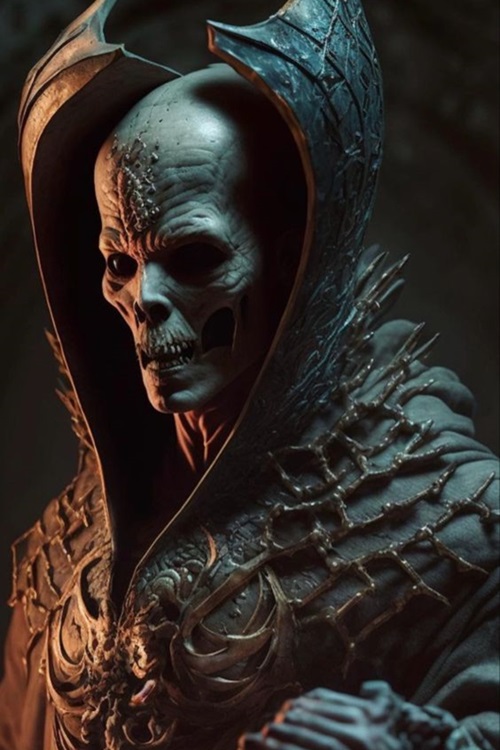
Shaezar

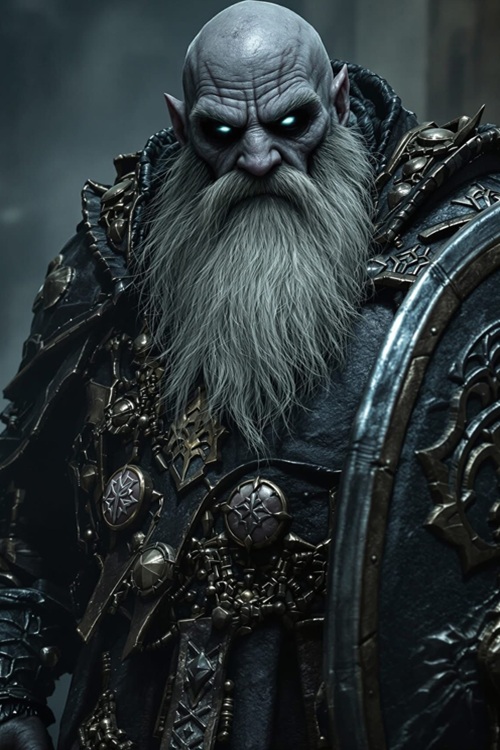

Ghoul fighters
Ghoul Priests
The lich's return
It begins with a straining silence, the air charged and brittle, as the three ancient relics pulse in eerie synchrony. A tremor ripples through the dust-laden amphitheater, and from its shadowed heart, the scattered bones of SHaezar shudder as if waking from a centuries-long dream. One by one, vertebrae twist and grind their way toward the center, assembling with a relentless, uncanny precision. Tibias rattle across the cracked stone, ribs arch and knit, each bone drawn as if by an invisible command.
Pale light flickers from the relics, weaving spectral tendrils around the forming skeleton. Where bone meets bone, sinew coils and stretches, translucent at first, then solidifying in glistening bands. Muscles sprout, twisting around the frame like vines reclaiming an ancient ruin. Veins pulse with ghostly ichor, suffusing the body with unholy vitality.
At last, the flesh follows—waxy and corpse-pale, knitting over raw muscle in waves, sealing ancient wounds and leaving behind a tapestry of runes and scars. As the final patch of skin smooths over the liche’s brow, SHaezar’s empty eyes flare with baleful green fire. The amphitheater stirs with a chill wind, the silence shattered by SHaezar’s first breathless, rasping exhale in centuries—a sound that heralds the return of the undying.
Yet even as SHaezar stands reborn, his form shimmers—less substance than shadow, caught between realms. His baleful gaze sweeps the chamber, but before mortal eyes can register triumph or terror, his corporeal shell begins to unravel, dissolving in a swirl of spectral mist. The ground beneath the amphitheater quivers, stone grates on stone, and a dark fissure yawns open at the epicenter.
Shaezar’s half-formed body slips soundlessly through the rift, sinking beneath the carved dais as if drawn by an irresistible summoning. The fissure seals behind him with a thunderous hush, the last vestiges of his presence echoing in the sudden void. Below, in the secret heart of his own lair—a sanctuary woven of shadow and memory—SHaezar awaits, gathering power in the gloom, the relics’ energies pulsing just above. The amphitheater stands silent, haunted by the knowledge that the undying liche is not gone, but gathering strength for whatever darkness is yet to come.
The sanctuary
The place is dark and moisty, the heavy air thick with the scent of earth long undisturbed. Moss clings to the ancient stones, and a cold sheen of condensation beads along the winding paveway, as if no living soul had set foot here for centuries. The hush is absolute—until, from deep within the gloom ahead, sharp noises fracture the silence: the unmistakable clash of sword upon armor, echoing and metallic, followed by the papery whisper of scrolls being unfurled. These sounds—faint yet insistent—seem to drift from nowhere and everywhere at once, threading through the corridor’s shadows like a summons. Each step forward feels heavier, the weight of the unseen pressing close, as if the darkness itself waits, bristling with secrets and the memory of ancient conflicts yet unresolved.
The entry room.
The entry room unfurls before you—a chamber of daunting scale, its chill palpable from the threshold. Shadows gather in the high, vaulted expanse, disturbed only by the glimmer of faint torchlight flickering against slick stone. Four statues stand sentinel: each a granite effigy of Shaezar, carved in different epochs, faces stern and hollow-eyed, gazes fixed forward as if weighing the souls of all who dare enter. Their forms are immense, draped in sculpted robes etched with cryptic symbols, hands outstretched in gestures that blur the line between welcome and warning.
Echoes linger in the cold air, the solemnity of the guardians pressing close—a presence at once reassuring and unsettling. The floor beneath their watchful eyes is a mosaic of fractured tiles, whose patterns spiral outward from the heart of the chamber, converging beneath the statues’ feet. At intervals, the green glow—a pale echo of the liche’s baleful fire—seeps from each statue’s hollow sockets, casting shifting shadows that writhe against the walls in silent mimicry of the undying.
As you cross the threshold, a sense of expectancy hangs, as though the stone visages are weighing your intentions, measuring the worth of your arrival. Each footfall resounds against the cavernous emptiness, but it is not loneliness that greets you: it is the ancient grandeur of a sanctum built to honor, or perhaps to imprison, a power that knows no rest. Here, the legacy of Shaezar is carved in silence and stone, and the vastness itself seems to lean in, listening for the next act in the unfolding dark.

Bloodthirsty Urge
The workshops.
Beyond the entry chamber, the labyrinth of Shaezar’s lair descends deeper into shadow, its arteries branching toward four secret workshops—each a sanctum of arcane purpose, reserved solely for the liche’s most private workings. Concealed behind warded portals of obsidian and bone, these rooms pulse with raw potential, the very air within vibrating with the residue of ancient spells.
The first workshop, known as the Hall of Unyielding Memory, is lined with shelves of eldritch tomes and glass vials, their contents swirling with captured echoes of the dead. Here, enchanted quills inscribe forbidden formulas onto endless scrolls, and wraithlike servants tend to cauldrons that bubble with memories distilled from eons past
The second, the Crucible of Living Stone, is a forge carved from the heart of the earth, its flames fueled by veins of primordial magic. Hammers drift through the air on their own, striking anvils with resonant force, shaping metals that shimmer between worlds. It is here that weapons and armor of uncanny resilience were born, blades that sing with haunted voices, shields inscribed with runes that repel mortal and spectral foe alike.
The third, the Vesperum of Shadows, is a chamber cast in perpetual dusk, where darkness itself is a malleable substance. Pools of ink-black liquid mire the floor, swirling with imprisoned spirits that grant power to those bold enough to bargain. Here, Shaezar wove cloaks that shroud the wearer from all divination, masks that steal the face and voice of any adversary, and talismans that open doorways into realms untraveled.
The fourth, the Scriptorium of Living Wills, hums with the ceaseless whisper of countless voices. Spectral hands drift over desks cluttered with half-finished relics—lockets, medallions, crystals alive with inner light. At the room’s center, a great crystal prism floats above a circle of runes, amplifying the liche’s intent into physical form. This is where the most potent and personal creations emerged: phylacteries to house fragments of immortality, keys to forbidden knowledge, and instruments to bind or break the souls of the worthy.
The power that lingers within these halls is palpable, humming in the stone, awaiting the master’s return or the touch of another bold enough to walk in the undying’s footsteps.
Ghoul fighters
Ghoul Priests
Shaezar.
Down the winding descent—a procession of ancient stone steps, slick with age and memory—the labyrinth’s breath grows colder, more reverent. The air thickens with anticipation as you reach the innermost sanctum, a place seldom touched by mortal presence.
First comes the antechamber: a solemn vestibule, hushed as a tomb, where the silence is so complete it presses against your ears. The walls, smooth and dark, are inlaid with veins of luminous crystal that pulse with a heartbeat not your own. Here, the spirits of the liche’s past adversaries drift in eternal orbit, their forms mere suggestions in the gloom, guardians by necessity or by curse.
Beyond, etched with sigils of mourning and remembrance, stands the chamber of Shaezar’s beloved. The sarcophagus rests atop an altar of black marble, ornate carvings of intertwining lives and lost possibilities spiraling down its sides. The air is sweet, touched with the faintest trace of lilies long since withered, and a gentle radiance bathes the coffin—an unyielding promise that here, at least, peace endures. The silence here is sacred: even the dust dares not settle, and all who enter feel the echo of a love undiminished by centuries.
At last, massive doors swing open on silent hinges, revealing the throne room—the very heart of Shaezar’s dominion. Vast and vaulted, the space is crowned by a ceiling lost in shadow, its pillars carved with the tales of the liche’s ascent and the suffering left in its wake. Torches of green fire flicker in sconces, their light reflected in the polished obsidian floor. At the far end, upon a dais of bone and silver, sits Shaezar—his form draped in regal decay, a crown of twisted iron upon his brow, cold eyes afire with unrelenting purpose.
He waits, motionless, resting one skeletal hand upon the pommel of a sword forged in his Crucible eons ago. Time pools around the throne, thick and unmoving. The air crackles with latent force; the weight of innumerable choices, betrayals, and victories hangs heavily.
Here, in the pinnacle of his power, Shaezar is both monarch and warden, judge and executioner. The throne room is more than a seat—it is a crucible for destinies, the arena where the living must face the undying, and the saga of the heroes will be forged or broken at the feet of the liche who has waited a thousand years for this reckoning.
Shaezar